The White House is one of the most iconic landmarks in the United States, attracting millions of tourists each year. Located in the heart of Washington D.C., the White House is rich in history and culture, making it an ideal starting point for exploring the city. Here, we will introduce eight top tourist spots near the White House that you can easily visit on foot.
The tourist spots we will be highlighting are all within walking distance of the White House, allowing you to easily explore these places.
Popular Tourist Spots That Attract Visitors from Around the World
The White House is the official residence of the President of the United States, located in Washington D.C., with a history of over 200 years. It covers a total area of 72,000 square meters and has 134 rooms. It is considered a symbol of America and is partially open to the public for tours.
However, visiting the interior of the White House is quite challenging, so this time we will introduce six nearby tourist spots where you can easily visit while enjoying the exterior of the White House.
White House Visitor Center

The White House Visitor Center is a tourist facility in Washington D.C. that houses exhibits on the history and culture of the White House, the official residence of the U.S. President.
The center features exhibits as well as a theater that regularly screens slideshows about the White House. It also has a museum shop operated by the White House Historical Association, where you can purchase original merchandise featuring the presidential seal. The Christmas-related items, in particular, are popular collectibles, often featured in guidebooks. The White House Visitor Center is a must-visit for tourists interested in the history and culture of the White House.

Located on the east side of the White House, at the intersection of ...
Eisenhower Executive Office Building

The Eisenhower Executive Office Building is a building located west of the White House complex and is considered one of the most beautiful buildings in Washington D.C.
Originally constructed in 1888 as the combined headquarters for the State Department, the Army Department, and the Navy Department, it now serves as the office space for the Vice President, the Office of Management and Budget, and the National Security Council.
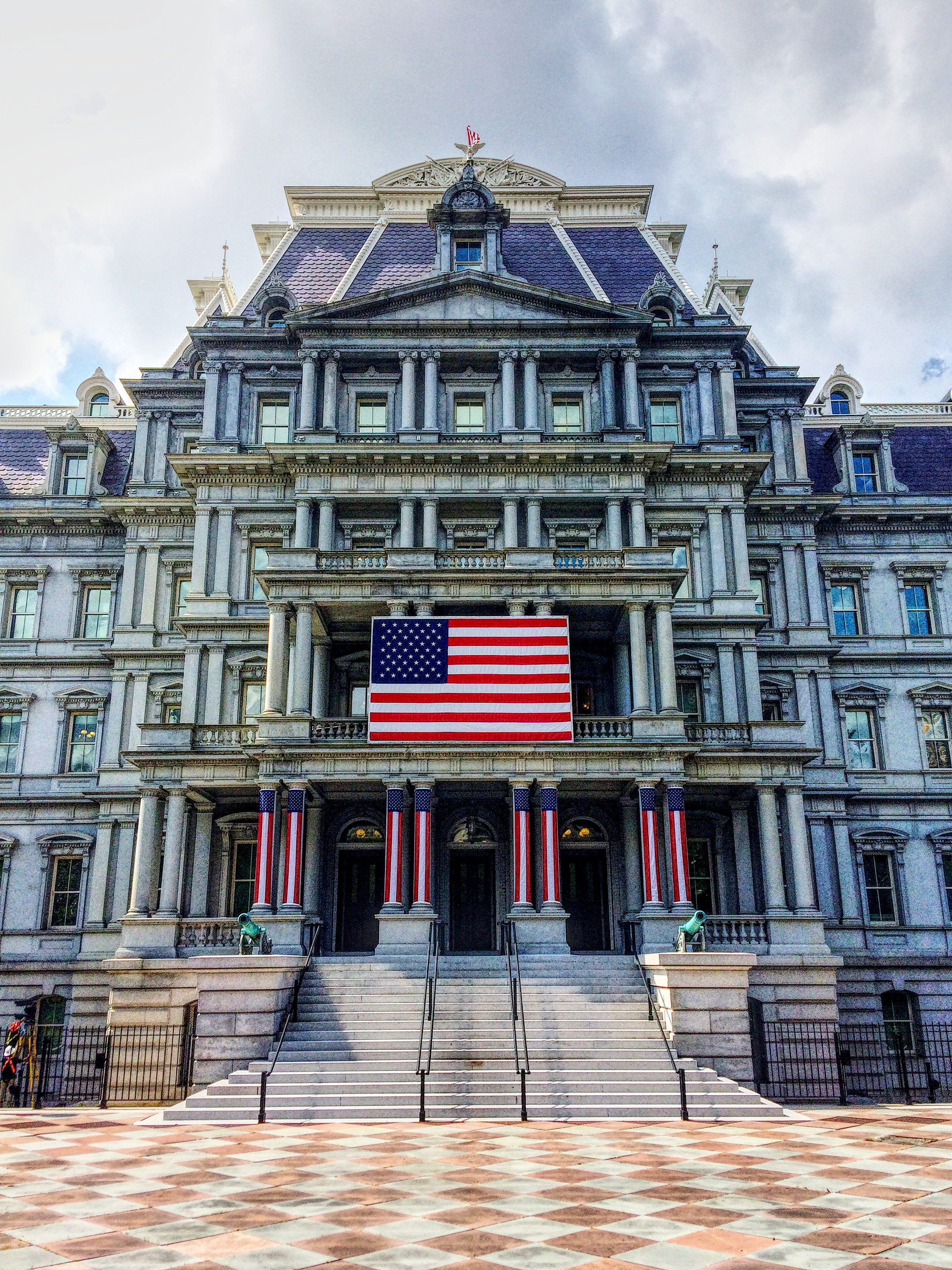
One of the attractions in Washington, D.C., is the Eisenhower Executiv...
Department of the Treasury Building

The Department of the Treasury Building stands opposite the Eisenhower Executive Office Building and plays a significant role in U.S. politics, economics, and fiscal policies. The building houses various Treasury Department agencies, officials, and related departments. While visitors are not allowed to enter the Treasury Building, you can admire its exterior from the outside.
If you have the opportunity to enter the White House, you will be able to see the south and west sides of the Treasury Building up close during the security screening process.

The Department of the Treasury Building serves as the headquarters for...
St. John’s Episcopal Church

St. John’s Episcopal Church is a historic Episcopal church located northeast of the White House. Built in 1795, this church has deep connections to the history and culture of the United States. St. John’s Episcopal Church is well-known for hosting worship services attended by many presidents and politicians, as well as for hosting official events. The church houses numerous artworks and historical memorabilia that visitors can explore.
St. John’s Episcopal Church holds worship services not only on Sundays but also on weekdays, making it an interesting spot for tourists who wish to attend a worship service while exploring the area near the White House.

In the United States, where a significant proportion of the populati...
Renwick Gallery

The Renwick Gallery is an art museum located west of Lafayette Square, just north of the White House. It is the closest Smithsonian facility to the White House. The Renwick Gallery features numerous exhibits of American paintings, sculptures, photographs, and other artworks, providing visitors with a chance to appreciate these collections.
Unlike other Smithsonian museums, the Renwick Gallery is relatively small in size, making it an easily accessible hidden gem for tourists.
The Renwick Gallery in Washington D.C., a museum designed by the 19th-...
Decatur House

Decatur House is a historic museum located along H Street, facing Lafayette Square to the north of the White House.
Built in 1818, this building is one of the oldest surviving residential structures in Washington D.C. and is recognized as an example of Federal-style architecture in the city. Decatur House was once inhabited by notable Americans, including Navy hero Stephen Decatur and several ambassadors.
Today, Decatur House is open to the public as a museum and is highly regarded as part of the city’s cultural heritage. Additionally, a section of the building that was once used as a stable now houses a shop operated by the White House Historical Association, where you can purchase official White House merchandise.

When visiting Washington D.C., one cannot miss the iconic tourist sp...
Zero Milestone

The Zero Milestone, located south of the White House, is one of the markers indicating the starting point of the U.S. road network. It serves as the reference point for measuring distances in the road network. The Zero Milestone is situated within the Ellipse grounds, just a short walk westward along Pennsylvania Avenue, a major road in Washington D.C.
The Zero Milestone is a granite monument approximately 6 feet (1.8 meters) tall, featuring a bronze disk with a diameter of about 18 inches (45 centimeters) embedded in its center.
The Zero Milestone Monument, located in front of the White House in Wa...
DAR (Daughters of the American Revolution)

DAR (Daughters of the American Revolution) is a research institution that focuses on women during the Revolutionary period, featuring research facilities, a library, and a museum. The staff at DAR, except for security personnel, consists entirely of women who are descendants of individuals who settled in America during the founding period. They conduct research and investigations on their ancestors and those from the founding period in their respective regions, collecting furniture and items used during that time, which are displayed in the museum. DAR also awards medals and offers scholarship programs to commemorate outstanding women from the Revolutionary period.

As one of the world's leading economic powers, the United States eme...
Explore Convenient Tourist Spots along with Washington D.C.’s Must-See Attractions
While the White House is a must-visit destination in Washington D.C., after capturing memorable photographs, be sure to explore the nearby tourist spots we have recommended.
Not only can you delve deeper into the history of the White House, but there are also many hidden gems in the vicinity that are often overlooked by Japanese tourists. By visiting these spots, you can enhance your travel experience and gain a greater understanding of Washington D.C.’s rich heritage.